
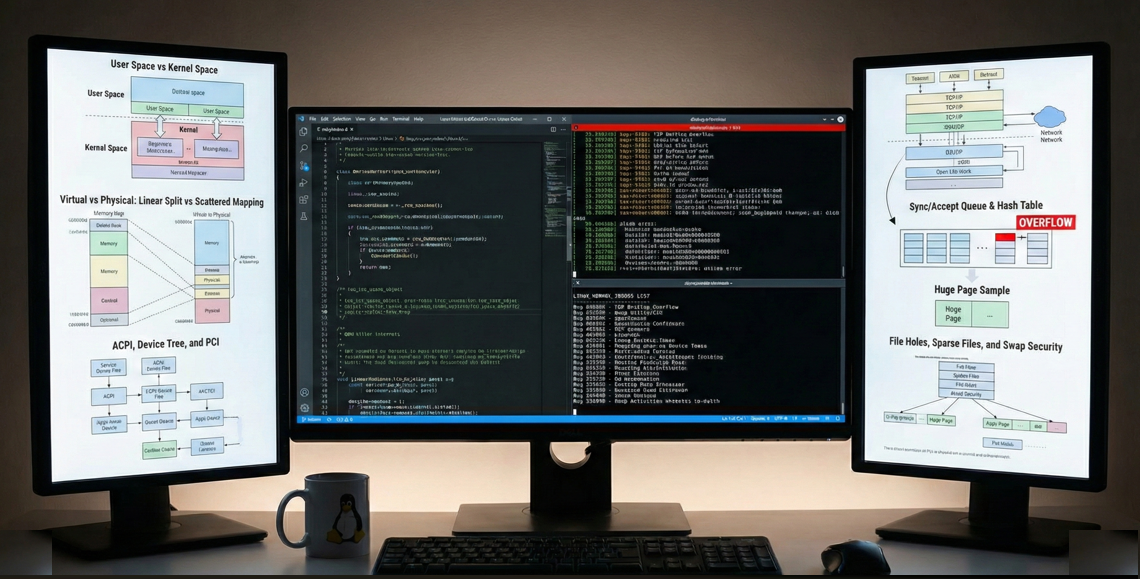
About Course
Master Linux Kernel Development Through Real-World Bug-Driven Learning
This is not a traditional theory-based kernel course. You’ll learn Linux kernel internals by analyzing, reproducing, and fixing real production bugs from kernel.org bugzilla. Every concept is taught through actual kernel issues, giving you practical skills that directly translate to professional kernel development.
Core Learning Methodology
Bug-Driven Kernel Mastery
- Learn kernel subsystems by studying real bugs that affected production systems
- Understand why kernel code is designed a certain way by analyzing actual issues
- Develop deep intuition for kernel architecture through hands-on bug analysis
- Build a portfolio of kernel patches as you progress through the course
Complete Bug Resolution Workflow
For every kernel bug covered, you will:
- Analyze – Study the bug report and understand the problem
- Explore – Navigate kernel source code to find relevant subsystems
- Reproduce – Use provided VM images or build custom reproducers
- Instrument – Add logging and tracing to understand execution flow
- Fix – Study the upstream patch and understand the solution
- Test – Validate the fix in isolated environments
- Document – Create visual diagrams and detailed analysis
- Contribute – Learn to submit patches following kernel standards
While bugs are continuously added, you’ll gain expertise across major kernel areas:
Core Subsystems
- Memory Management (MM subsystem)
- Process Scheduling and Task Management
- Virtual File System (VFS) and File Systems
- Networking Stack (TCP/IP, packet handling)
- Block Layer and Storage
- Device Drivers and Hardware Interaction
- System Calls and Kernel Entry Points
- Locking and Synchronization Mechanisms
Fundamental Concepts
- User space vs kernel space architecture
- Virtual memory and address space management
- Interrupt handling and bottom halves
- Kernel threading and work queues
- Reference counting and object lifecycle
- Error handling and resource management
- Hardware abstraction and platform support
- Boot sequence and initialization
Advanced Topics
- Race conditions and concurrency bugs
- Memory corruption and use-after-free issues
- Performance bottlenecks and optimization
- Security vulnerabilities and hardening
- Compatibility and regression issues
- Cross-architecture considerations
- Kernel configuration and build system
Course Content
Linux Kernel Issues List
-
Linux Kernel Issues List
-
Bug to start with
Linux Kernel – Analyzing Crash Dump – Ex: 218536
Case Study 1 – Huge Page
Case Study 2 – OOM Killer
Case Study 3 – Memory Management Deep Dive
Case Study 4 – Bug 60665 – TCP Backlog Overflow Fix
Case Study 5 – Bug 209949 – swap is not activated
Case Study 6 – What is User Space and Kernel Space ? What Actually Makes “User Space “User Space”
Case Study 7 – How does the kernel discover the hardware?
Case Study 8 – Core Memory Management Initialization
Case Study 9 – Memblock Allocator Guide Reference Kernel 5.15.0-rc1
Case Study 10 – PCI Device Discovery in Linux Kernel
Student Ratings & Reviews

No Review Yet